


 "I think trainers should take more responsibility; before focusing on winning classes, riders first need to have a connection with their horse," the 2010 World Champion Philippe Le Jeune tells WoSJ. Photo © Nanna Nieminen for World of Showjumping.
Text © World of Showjumping
“Horsemanship is all about the connection you have with your horse,” the 2010 World Champion Philippe Le Jeune tells World of Showjumping. “Taking care of your horse is the most important thing. We need more focus on this, because if we lose this connection our sport will be going in the wrong direction. I see too many young riders and juniors having grooms do all the work; they end up not knowing their horses and they don’t create a proper connection with them. I think trainers should take more responsibility; before focusing on winning classes, riders first need to have a connection with their horse.”
I love horses more than competition
“I never dreamed of being ranked number one in the world,” Le Jeune continues. “For me, the world ranking is absolutely not important and it doesn't mean anything. Real horsemen like John Whitaker are always number one for me – no matter what their ranking might be. I'm not a fan of the world ranking and never have been. I love horses more than competition.”
 “I have always loved working with young horses and bringing them up to higher levels. That's what I do now," Le Jeune – here pictured at the 2010 World Equestrian Games with Vigo d'Arsouilles – tells. Photo © Jenny Abrahamsson for World of Showjumping.
At the 2010 World Equestrian Games in Lexington, Kentucky, USA, Le Jeune and the horse of his heart, Vigo d’Arsouilles (Nabab de Reve x Fleuri du Manoir), were crowned World Champions and won team bronze with the Belgian squad. A dream came true for Le Jeune in Lexington, who had competed at three World Equestrian Games prior to 2010: At the 2002 World Equestrian Games in Jerez de la Frontera, Spain, with Nabab de Reve, in Rome, Italy, in 1998 with Double O’Seven, and in Den Haag, Netherlands, in 1994, with Shogoun II. During his career, Le Jeune also jumped at nine European Championships and at the 2012 Olympic Games in London.
In recent years, Le Jeune has worked alongside the Belgian chef d’equipe Peter Weinberg, and in 2020 he was appointed as chef d’equipe for the Moroccan jumping team. However, the 65-year-old father of four has still kept on competing at a lower international level and continued to develop young horses.
To World of Showjumping, Le Jeune shares his thoughts on horsemanship – challenging the status quo.
Happiness is found at home
 “I like to see my horses happy; I enjoy going to the sea with them, taking them in the woods and having them in the field,” Le Jeune says. Photo © Nanna Nieminen for World of Showjumping.
-
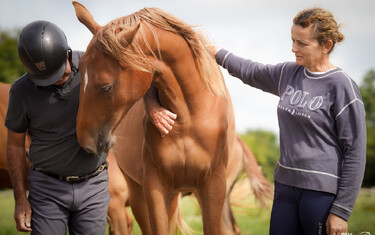 Photo © Nanna Nieminen/WoSJ.
-
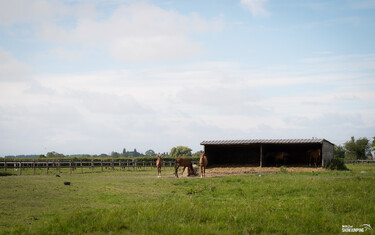 Photo © Nanna Nieminen/WoSJ.


Le Jeune runs a stable together with his wife Lucia Vizzini in Averingem, Belgium. “We have a small stable and we want to stay small because we want to control everything and do things properly,” Le Jeune tells.
It's unbelievable how riders are at a show all the time, chasing ranking points
“I don’t fancy going to lots of international shows week in and week out,” Le Jeune tells. “First of all, everything is much more expensive now so the added costs of competing at FEI events are significant for us. Secondly, I have actually never been interested in going to the shows every week, which is what people are doing nowadays. It's unbelievable how riders are at a show all the time, chasing ranking points. Many of them say they don't chase points, but why are they going to the show every week then? It's not my thing, and never has been. I like to do some nice shows, and then come back home to train – and that is what I did throughout my career.”
“I like to see my horses happy; I enjoy going to the sea with them, taking them in the woods and having them in the field,” he continues. “I have always loved working with young horses and bringing them up to higher levels. That's what I do now.”
 “We have a small stable and we want to stay small because we want to control everything and do things properly,” Le Jeune tells.
-
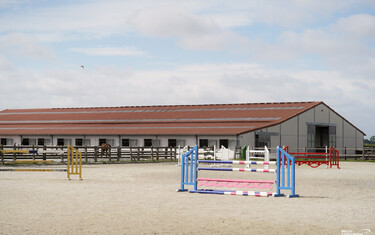 Photo © Nanna Nieminen/WoSJ.
-
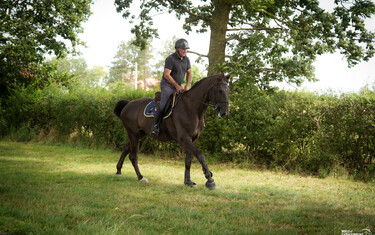 Photo © Nanna Nieminen/WoSJ.


“My two daughters, who are six and ten, have started to do small pony shows and I enjoy watching them learn,” Le Jeune continues to tell about his day-to-day life. “Before a show, they clean their tack, so it all looks well. It does not have to be expensive tack, but it has to be clean and shiny! In the morning of the show, even if it can be very early, they take care of their ponies themselves; they get them from the field, feed them, wash their mane and tail, groom them. They know what their ponies are eating, they know how much hay they get, and this to me is what horsemanship is all about; the contact with these animals and the knowledge about them.”
Although Le Jeune enjoys staying at home, he also likes to travel to share his experience. “I give a lot of clinics,” he tells. “I really like teaching and sharing my experience with other riders, especially the younger generations. I've always done this, but now I have even more time for it.”
The ever-increasing numbers
 “I think there's always positive and negative change,” Le Jeune says about the development in the jumping sport over the last decades. Photo © Jenny Abrahamsson for World of Showjumping.
A lot has changed on the international show scene since Le Jeune’s most active years. “I think there's always positive and negative change,” he points out. “Today, there are much more riders and much more horses. In the past, if you had 50 riders in a five-star Grand Prix there were about ten who realistically could win. Nowadays, about 40 of them could win.”
“When it comes to horses, there has always been superstars,” Le Jeune continues. “I don't agree with riders who argue that horses are better now than before. No, they are not better – but there are many more good horses than before. However, the best horses from over 25 years ago would still win today.”
Getting to the highest level is nearly all about money as it requires huge resources
“Furthermore, another significant change is that everything has become much more expensive. Getting to the highest level is nearly all about money as it requires huge resources. As a rider you need to have sponsors or horse owners to pay all these bills,” Le Jeune points out. “Riders go from one show to another, some of their horses are at one venue, meanwhile the other horses have already left with another lorry and another groom to the next show. You need incredible amounts of resources and staff to organise all this. I have a lot of respect for anyone who can pull it off.”
“Everyone competes much more than before, including young riders,” Le Jeune continues. “They do way more shows at a young age than we did. When I was 16, I did not show this much. Nowadays, there are riders who are 16 or 17 and already have an incredible amount of show experience.”
A competitor, but not at all costs
 "I have made a lot of mistakes in my life with horses, and I have no problem admitting that; I became a better horseman because of them. I always wanted to be a better horseman than a rider, but you have to be honest with yourself," Le Jeune says. Photo © Nanna Nieminen for World of Showjumping.
Rather than running from show to show, Le Jeune’s focus has always been on the training at home. “I've been taught the old way, by Nelson Pessoa,” he says. “When I was a kid, the idea was to train at home and then go to the show to see if the training had worked. What the majority of the kids are doing now is that they don't train at home – because they're never at home. They're at the show, and even though they have a lot of experience in the ring, they lack the technical basics. However, to get to the highest level, you need the basics – there is no way around it.”
“I've always been a very good pupil and very serious about learning, aiming for perfection,” Le Jeune says. “I love to ride my horses on the flat and have them work like music; dancing and soft, moving left and right, sound and happy. I love the feeling of a loose horse on a simple snaffle, when you can do every move easily.”
I think riders and owners perhaps should sit down and take an honest look at what they are doing
“I'm a competitor, but not at all costs,” Le Jeune continues. “I believe that horses are not made to compete as much as they do these days. They are not made to be put on the plane or the lorry and then jump 1.60m classes for three days in a noisy, stressful environment. I'm not sure that this is the best for the horses."
"I hear some people say how their horses love to go to the show – but I don't agree. If horses like the atmosphere at shows, why are more and more horses wearing special masks on their faces and have their ears stuffed to keep them calm? When the horses go on the lorry, they don’t know if they are sold, if they are going to the clinic or if they are going to the show. A horse lives in the moment, not in the past, and not in the future. It is true that some horses need more competitions than others, but there should be limits. As an example, Vigo won the World Championship by doing only four shows that year – and everything was organised with just this goal in my mind back then.”
 “I've always been a very good pupil and very serious about learning, aiming for perfection,” Le Jeune says. Photo © Nanna Nieminen for World of Showjumping.
Le Jeune believes that restricting the number of competitions a horse can do would also help with the current pressure from different animal welfare groups. “I think riders and owners perhaps should sit down and take an honest look at what they are doing,” Le Jeune says. “I don't think horses have been made to do the amount of shows they do nowadays and fly from one continent to the other several times per year."
“I think it's normal that some people get angry when they see a close up of a situation where a rider is too hard on their horse," Le Jeune continues. "There must be rules. As an example, in my opinion, there is no way to justify a spur mark by saying it is “not so bad” – in my opinion, cutting a horse is never ok, period. Doing that to any animal is not ok, and especially not to a horse, an animal that gives so much to us.”
"I have made a lot of mistakes in my life with horses, and I have no problem admitting that; I became a better horseman because of them," he points out. "I always wanted to be a better horseman than a rider, but you have to be honest with yourself.”
Back to nature
 “A good horseman is somebody who takes care of his horses’ well-being, both mental and physical, and makes a nice programme for them – doing only what needs to be done,” Le Jeune points out. Photo © Nanna Nieminen for World of Showjumping.
When it comes to his own horses, Le Jeune believes in letting them live as natural as possible. “I think horses should be outside,” he explains. “In my opinion, even the most beautiful stable in the world is always a prison for a horse because a horse should not be locked inside.”
“Another thing I don’t like is that we have machines to train horses,” he continues. “Do we really need machines like walkers and treadmills to make our horses stronger? Wouldn't it be better that someone puts a saddle on them and goes out for a hack? Horses need attention and contact, and they will be much happier to give back to you when you give your time to them. That's why I don’t think it is ok to use a machine to make them work.”
I think horses should be outside
“We have had quite a lot of success with horses who were injured or not performing anymore,” Le Jeune tells about how he has developed a program to help bring horses with health issues back to the sport – specifically using the North Sea for rehabilitation purposes. “We don’t do anything special other than giving nature back to them.”
“A good horseman is somebody who takes care of his horses’ well-being, both mental and physical, and makes a nice programme for them – doing only what needs to be done,” Le Jeune points out. “Keeping horses fresh is very important; you need to have shows where horses get to do some smaller classes. Horses should not find a 1.60m course in front of their nose every time they enter the ring. I think this is very important."
Horse welfare vs money
 “I have always been against paycards. I see riders at big shows who are not experienced enough to compete at that level. The FEI should put a stop to this once and for all because it contradicts horse welfare,” Le Jeune says. Photo © Jenny Abrahamsson for World of Showjumping.
“Today, there are two separate levels within our sport; a level for those with money, and another for those without and that creates an unlevel playing field,” Le Jeune says when asked how he sees the future of equestrian sport. “Those who have the money buy expensive horses, and a VIP table at a show to compete. I’m sad to say that at this moment, even if you work hard, it is very difficult to make your dreams come true without significant financial support. We have kids with talent who have no money, and, in my opinion, they don’t stand a chance.”
The ethos should be that the one who works the hardest and has the most talent, arrives at the top
“Normally, the ethos should be that the one who works the hardest and has the most talent, arrives at the top,” Le Jeune continues. “This is what happens in other sports, like tennis, swimming and football. In tennis, you don’t buy a VIP table to get to play at Wimbledon, even if you're rich, you cannot buy a spot. In other sports, you need to go through all the stages, work hard, become better and win. Our sport has become ruled by paycards.”
“I have always been against paycards. I see riders at big shows who are not experienced enough to compete at that level. The FEI should put a stop to this once and for all because it contradicts horse welfare,” Le Jeune says. “Money or no money, horses should not be put in unfair situations. Riders should be required to have a certain number of results on each level before being able to enter bigger classes, and make a step up. It should not be possible to buy a horse and buy yourself a place at a five-star show. This has nothing to do with horse welfare; it is only about money.”
Riders should be required to have a certain number of results on each level before being able to enter bigger classes
“I love to watch Formula One because you know you are watching the 20 best drivers in the world – and I love to watch a five-star show with good riders. I respect them, they're unbelievable with the feeling they have, and it's like music when they ride. However, I don't enjoy watching people who don’t belong in a five-star Grand Prix taking a place from another rider who would deserve to be there,” Le Jeune says. “These people bring money to the shows, to the organisers and to the trainers – but are we talking about sport, or are we talking about business? Right now, it seems to be too much about money and not enough about sport.”
The happiest man in the world
 "Horsemanship is all about the connection you have with your horse,” Le Jeune says. Photo © Nanna Nieminen for World of Showjumping.
Fifteen years after winning the World Championship, Le Jeune fondly looks back at how it all began. “When I was a child, I watched the World Championship at Hickstead in 1974, on BBC,” he recalls. “I remember the final four like it was yesterday; Hartwig Steenken won and Eddie Macken was second, with only time faults separating them. Four years later, I went to Aachen to watch the final four, and Eddie Macken was second again – this time with Boomerang, but again, with time faults. I was a little kid, and I didn't know a lot about showjumping. However, I told my parents that I wanted to win the World Championships and do it by jumping clear, with no penalties! Not one mistake, that was my dream.”
All I knew was that I wanted to spend my life with horses
After being crowned World Champion in 2010, Le Jeune was met back home in Belgium by a media frenzy – something the peace-loving horseman found difficult to cope with. “It was quite hard for me to stay organised,” he recalls. “The win was like a tsunami; in Belgium, it was huge news. All of a sudden, the press needed me everywhere, while all I wanted to do was go back to my horses. I couldn't cope with all the attention.”
 “For me, the world ranking is absolutely not important and it doesn't mean anything," Le Jeune says. Photo © Nanna Nieminen for World of Showjumping.
While World Champion-title was a dream for Le Jeune, fame was not – he has always dreamed of a simple life. “In school, a teacher once asked us to write down what we would like to do with our lives,” he recalls. “One wanted to be a dentist, the other a doctor, the next one a lawyer. The class was finished and my answer was not read out loud. Instead, my teacher pulled me to the side after the class, took my paper and asked what my answer was about. I had written down ‘I want to live with horses’. It was very simplistic, but they had asked me what I wanted to do with my life… My teacher kept asking how I was going to make money, what kind of profession this was – and I had no answers. All I knew was that I wanted to spend my life with horses.”
And Le Jeune has done just that. “At home, we have horses in front of my kitchen window, I see them from my bedroom,” he tells. “And I'm happy like this. This morning, we went to the sea with the horses. The weather was nice, the sea was quiet, the tide was low. We galloped around – and I was the happiest man in the world.”
12.8.2025 No reproduction of any of the content in this article will be accepted without a written permission, all rights reserved © World of Showjumping.com. If copyright violations occur, a penalty fee will apply.






 Then
Then