


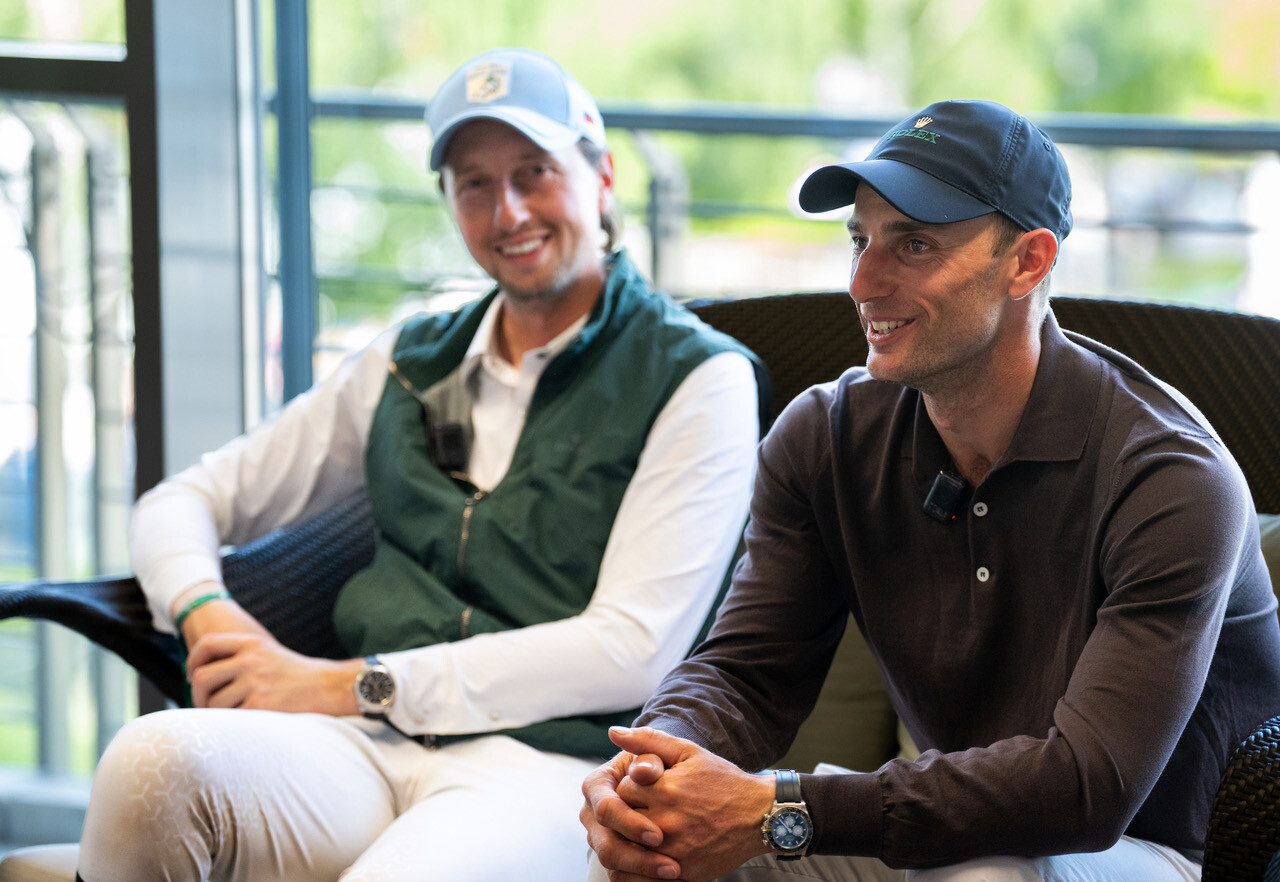
 Rolex Testimonees Martin Fuchs and Richard Vogel. Photo © Rolex.
Rolex Testimonee Martin Fuchs, who triumphed in the Rolex Grand Prix at CHIO Aachen in 2025 with Leone Jei, and Richard Vogel – who joined the Rolex family of Testimonees in 2024 and has arrived at TSCHIO Aachen as the Rolex Grand Slam of Show Jumping live contender, following his victory with United Touch S at The Dutch Masters earlier this year – met with media representatives during a Rolex Round Table on Saturday.
This special edition of TSCHIO Aachen celebrates everything that makes Aachen such a unique venue – its history, atmosphere and connection with the sport. What makes competing here so special to both of you?
Richard Vogel:
I think Aachen is, for any rider in the world, one of the best shows. For me personally, it is the best show. It is definitely my favourite show of the whole year. It is in Germany, which makes it extra special for us Germans.
It is a show I remember watching as a small child in my grandpa's living room on television, dreaming that one day competing in Aachen would be something incredible. Now, being here and being able to compete with horses like United Touch S is a real dream coming true. As soon as you ride into the main stadium and experience that atmosphere, and the environment that the public creates, it is something very special. It gives you goosebumps.
Martin Fuchs:
I agree with Richie. Aachen is the mecca of our sport – the greatest venue, the best crowd and one of the nicest competitions, with the most challenging Grand Prix, the Rolex Grand Prix. I love competing here. Like Richie, yesterday morning, when I entered the arena for the first time this year with Leone Jei, I was standing at the in-gate when the announcer started to introduce the class, and I really had goosebumps all over my body as we entered the arena. Even though we have many very nice shows, this is rare. You do not get emotions like this anywhere else.
Richard, you arrive at your home event as the Rolex Grand Slam of Show Jumping live contender. How excited are you to bring that momentum into such an iconic venue, in front of the German crowd?
Richard Vogel:
It is very exciting. As I mentioned, Aachen is always a main priority in our show calendar. Coming here as the Rolex Grand Slam of Show Jumping live contender adds a bit of extra pressure for sure, and gives it even greater importance. Nevertheless, we always want to compete well here in Aachen. We always want to try our best, so it does not really change anything in our planning. Everyone brings their best horses, especially for the Rolex Grand Prix on Sunday. I have United Touch S here, the horse who made us the live contender after winning the Rolex Grand Prix at The Dutch Masters in 's-Hertogenbosch. With him, I will try to do the same tomorrow.
Martin, you return to Aachen with memories of your Rolex Grand Prix victory here last year. What does that mean to you personally, given your family's own history and success in the sport?
Martin Fuchs:
It was definitely a very special feeling, 23 years after my uncle. I still remember his jump-off at the time with Tinka's Boy, beating Christian Ahlmann by two-hundredths of a second. It was a very special victory.
Coming back here and being able to compete in and win the Rolex Grand Prix myself was an incredible feeling, with a lot of emotion. I had already been quite close to winning once or twice before, but it had not gone as I wanted in the last moments, and I made some rider mistakes. Last year, I was really determined to eliminate those mistakes as much as possible and give my horse the best chance to succeed.
At a venue as atmospheric and technically demanding as Aachen, how important is the trust between horse and rider, and how do you begin to develop that relationship at the very top of the sport?
Richard Vogel:
I think it is crucial. Every year, when we come back here, we make experiences with horses that perhaps have not been in our string for very long. It can be quite tough here in Aachen, in this stadium and with this atmosphere.
If horses go in and they have a good bond with you as a rider, and with the whole team supporting them, then they can grow with the atmosphere. They can become a little taller, and they have the confidence they need. If that bond is not 100% there yet, horses can also go in and shrink a little, and become very shy.
This year, I have a very promising horse for the future, Cardentos. In the first class, it went terribly – it could hardly have gone worse. We came here with the best intentions and thought it would be a very good week. He was here for the smaller classes in the five-star tour, but after that first round, I did not compete him again. We have simply not been together long enough. I have had him in my stable for four or five months, and clearly the relationship is not yet strong enough to compete well in an atmosphere like Aachen.
That shows you, as a rider, more and more how important it is to have that bond and confidence between horse and rider – to trust each other and to deliver in the toughest classes, in the most challenging environments.
Martin Fuchs:
Here in Aachen, it is definitely totally different from any other show for horse and rider. I usually try to bring more experienced horses to Aachen because, as Richie said, you never really know how they will react here. I try to let the horses have a few other nice grass shows before coming here.
But sometimes there is a new horse that you want to bring, and there will always be a first time for them. Then you have to make decisions – maybe not to compete again the next day, and instead work better with the horse for the future. That is a very interesting part of our relationship with horses. It does not always go well and, actually, many times we struggle. We have questions that we ask ourselves. We are not always sure how to ride a horse or what to do better. Every day when I get on a horse, I try to improve a few small things and work on specific points that I feel should or could be improved. With these tiny steps, hopefully one day you have another horse that can win here in the Rolex Grand Prix.
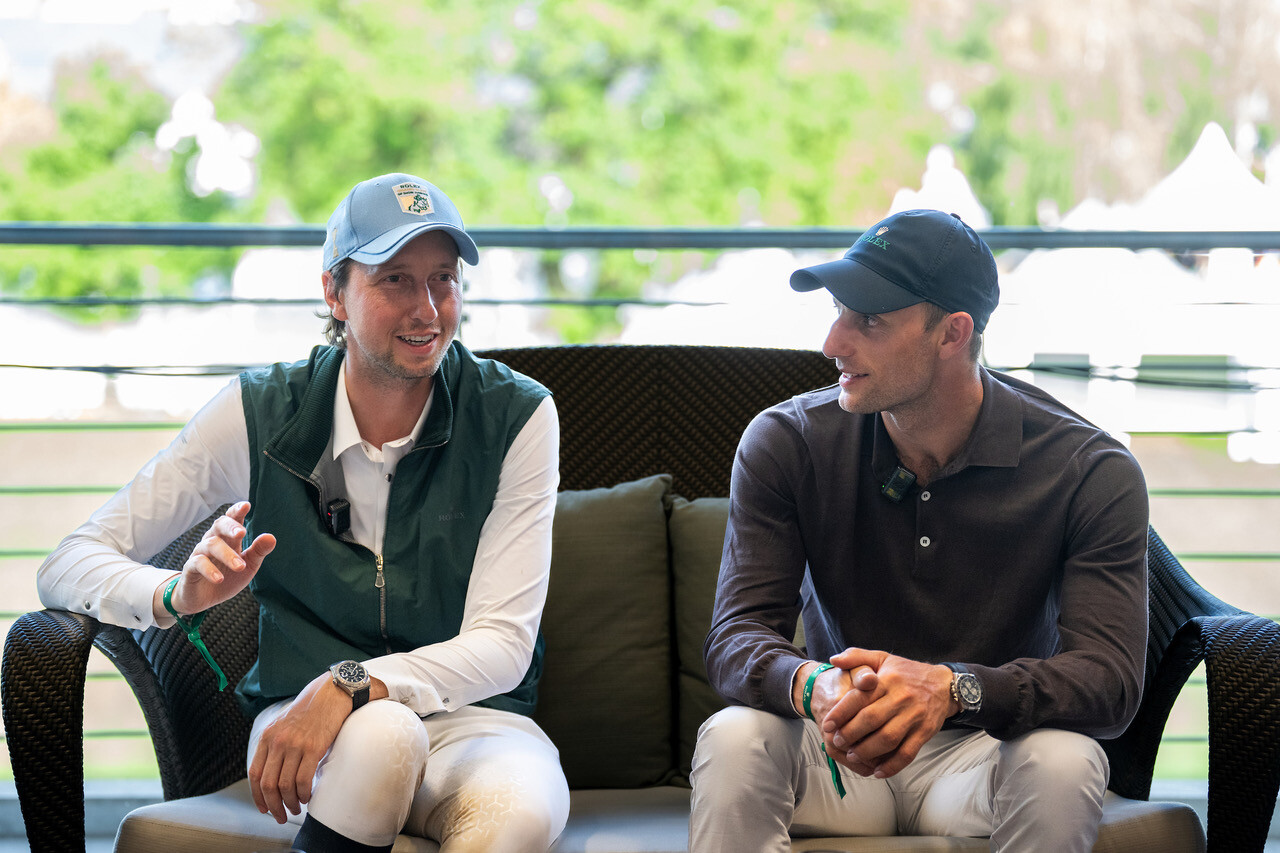 "The four Rolex Grand Slam of Show Jumping Majors are really the pinnacle of our sport, and winning here in Aachen is probably one of the best achievements you can have," Richard Vogel says. Photo © Rolex.
Rolex Grand Prix victories are moments that recognize precision, excellence and achievement against the clock. For both of you, what does it mean to win at this level and to be awarded a Rolex watch as part of that achievement?
Richard Vogel:
The four Rolex Grand Slam of Show Jumping Majors are really the pinnacle of our sport, and winning here in Aachen is probably one of the best achievements you can have. It is something very special, a dream coming true.
Every year it is competitive, but especially this year there is such depth in the field, with so many good riders and horses here. I think 28 of the top 30 riders in the world are here, so that gives you an idea of how competitive it will be on Sunday. Everyone has their focus on the Rolex Grand Prix on Sunday. No one tries to take too much out of their horses on Friday and Saturday; everyone is here to peak on Sunday.
I think what we have seen so far has been great sport, but it will be a totally different level today. I am already excited for it. Of course, I also need to compete and be focused, but I think we will see great sport, and I cannot wait to experience it. The first round will be tough. Then only the best come into the second round, and it can build again. Then it comes down to the jump-off and it will be absolutely thrilling.
Martin Fuchs:
For sure. Today, everyone is here, all the best riders and horses. Waking up on Sunday morning is always so exciting, knowing you will walk the course and see what Frank Rothenberger and his team have designed. It is always one of the most difficult Grand Prix of the year, if not the most difficult. It takes a lot from us riders and from our horses to perform well.
It is not really just the size or height of the fences. It is also the pressure you have when you go into the Soers, the crowd, and the atmosphere that builds throughout the week. Even Saturday, the stands were already full and there were people everywhere. The horses feel it as well. When they come from the stables and walk towards the warm-up, there are people everywhere, and you can tell that something is changing throughout the week.
Today, when it is packed and all the riders are a bit nervous, the warm-up is not the same anymore. People become more tense and it gets more hectic. Then it is our job to stay calm, to keep our horses calm, to be calm ourselves, and then to go into the arena and do our job.
How do you prepare mentally for the Rolex Grand Prix? Do you watch videos the day before or the night before? Do you watch your other competitors?
Martin Fuchs:
It is always a little bit different, to be honest. I do not have one fixed routine. It depends on the horse and on the feeling I have with the horse. Sometimes I watch videos. Last year with Leone Jei, I watched my rounds back on Saturday night and studied what could be improved. Other times, I just watch a couple of rounds, or nothing at all. It depends on what I feel I need on that day, and what I need to give my horse the best chance.
Richard Vogel:
It is a bit the same for me as for Martin. It is always a bit different. What I really like to do at special places like Aachen is to watch some Rolex Grand Prix rounds from previous years. I find that course designers always follow a little bit of the same pattern. It is like us riders – we have our style, and they have their style. They have experienced what worked in previous years and what did not work so well. The lines may be set together in a different way because, obviously, they design a different course, but there are often similar patterns and technical questions.
At a place like Aachen, the horse’s stride opens up much more. If you walk a normal eight strides, many people do an easy seven, and some others do a very short eight. In a different arena, it would be eight for everyone. It is almost a different scale of canter, stride and room in the canter that the horses get here.
I like to watch back and see what the difficulties were in previous years and how different riders managed them. I try to look for horses that also have a big stride, like United Touch S, and see how they handled those questions. Often, that has helped me quite a lot. For instance, with my first Rolex Major win in Geneva, I remember very well that I watched the jump-off from the previous year when I went to bed on Saturday night. It was such a thrilling jump-off. Already by the fourth rider in, you thought, that was it – it was impossible to go quicker. Then Daniel Deusser, who was the live contender at the time, was even quicker. You thought, okay, now that is it, and I think in the end he finished fourth or even fifth, and McLain Ward won that year.
The year after, I happened to be clear in the first round, but I was quite early in the order for the jump-off. Going first in a Rolex Major, normally you might think to play it a little bit safe. But from watching the jump- off the night before, I knew that if you are first to go, you really need to give it everything. Luckily, United Touch S produced an unbelievable performance that afternoon in the jump-off, and it was very tough for the others to beat. If I had not watched the previous year's jump-off the night before and taken some inspiration and motivation from it, I do not think I would have risked that much.
Richie, you also work with the breeder of United Touch S, who is still his owner. What extra value does this partnership give you, especially because you are also interested in breeding?
Richard Vogel:
Absolutely. I think it is an obligation for all of us riders to be interested in where our horses come from. We do not all have the possibility to have a big breeding stable ourselves, but at least we have to be interested in the breeders and in how we, as sport riders, can help them, because we really rely on them. With no horse breeders, there are no horses, and with no horses, there are no show jumpers. That is something we really have to keep in mind for the future. We have to take care not just of the top level of show jumping. It is amazing for us to have venues like Aachen, and every year there are more five- star shows and more competitions to choose from but the basis of the sport is the breeders. Often, in my opinion, they get a little bit forgotten.
For instance, Julius-Peter Sinnack, United Touch S's breeder, has already bred so many good horses. He is a great horseman and a great breeder. I really admire him. He actually does not have many broodmares for the number of five-star horses he has bred, so it is something I look up to and try to learn from. He always laughs a little bit about me because he says, "You try to ride; I do my breeding thing. It is not really your expertise." But you get wiser by listening to someone like Julius and trying to learn from him. We have many other horses of his that I ride, and some that we own together, like the youngster I am showing here. We own him half together, which is a lot of fun. It is very nice to know where the horses are born, where they grow up, and in whose hands. The people who work for Julius have been there for many years, and they have known United Touch S since he was a baby. Every now and then they visit him, and it is a very nice story.
Today it will be about winning the Rolex Grand Prix, but also about being convincing for your Chef d'Equipe. Do you have that in mind, and what do you think about your chances so far for the World Championships?
Richard Vogel:
You are absolutely right. It can either be a win-win situation or a lose-lose situation. It is definitely in mind. I think that is one of the reasons why this year's field is so strong here in Aachen and why everyone has brought their best horses. All eyes are on Sunday's Rolex Grand Prix, including those of the Chefs d'Equipe. What better performance, or what better message, could we give them than to perform well in the arena where the World Championships will take place, with the sand arena already in place, the same course designer and similar materials?
I think this is probably one of the most important shows leading towards Aachen, where we need to do well, and that is for sure in all of our heads. It definitely adds an extra flavour to the Rolex Grand Prix tomorrow.
The extra pressure for the Rolex Grand Prix, is it mostly coming from yourself, or from expectations from people around you? Is it positive or negative to have this extra pressure as last year's winner and as the live contender, and how do you handle it?
Richard Vogel:
It is definitely pressure that is there, and that you can feel and recognize. I have to say I am probably lucky to have been born with good nerves. I usually perform better in situations where there is pressure, where there is tension in the air and where you know: now you really need to be there 100%. That is easier for me than situations where it does not count quite as much.
What I experienced over the last year is that when I won my first Rolex Major in Geneva, I came there a bit as an underdog. No one really had me on the list as one of the favourites to win the Rolex Grand Prix. To have such a performance and win the Rolex Grand Prix there, with such a jump-off, was an outstanding feeling and something we will never forget, because it came quite unexpectedly – for everyone else and even a little bit for us, even though we knew we were in good form and knew our horse's strengths. We had just not really proven it yet. Now, more and more, we are in the role of one of the favourites – coming here as the live contender. You have big expectations to meet from other people: the inner circle, but also people you do not really know. They see you at the show and say, "You will win on Sunday," or "You are my favourite to win the Grand Prix." That puts you in a different role and a different position.
Sometimes, if you have one down or two down, it was actually still a good round, but you are not really living up to the expectations people have for you, and you sometimes feel like you are letting them down a bit. It is not that they have less in their lives because of that, but emotionally you feel like you have let some people down, and that is not a great feeling. That is something I needed to learn to deal with.
For the rest, I think I am lucky enough to normally do well in those pressure situations. It is a privilege to be here as the live contender. Everyone who is cheering for me, I will try to take that as wind at my back and as motivation, also for United Touch S. We try to keep it as something very positive and motivational. With the sensitive horses we have, it is very important to stay quiet. The pressure is a privilege, and we need to live with it and deal with it.
Do you think modern riders today think differently compared with, say, five or 10 years ago?
Richard Vogel:
Our sport is constantly changing and developing. I am not sure how different it was five years ago, but for sure 10 or 15 years ago we probably had half the number of five-star events that we have now. I think this year was the first year that we had more than 100 five-star events in one year, which is incredible.
But it also puts us in a situation where we really have to make a good plan with our horses. The depth of riders is getting better and better. The level of competition is coming closer together. There are so many riders who can win the Rolex Grand Prix here on Sunday. I think 25 years ago there were maybe five names who could win it, and the others were there to compete but were probably not among the favourites. All those good riders need good horses, and they all want to set themselves up with a strong string of horses. Horses nowadays almost become a little bit rare. After having a horse like Leone Jei or United Touch S, it is very hard to find the next superstar, because everyone is looking for them. Riders are starting to search for them younger and younger.
In the past, you would not see so many five-star riders having so many young horses in their programme at home. But this is part of the development. Riders try to secure their superstars as early as possible because, if you are too late, the horses are simply not on the market anymore. There are so many riders nowadays looking for those horses and able to ride them because the level of riding is better. So in a way, they become rare, even though we probably have better horses than many years ago. There is also more demand for them, and more competition.
In our position, it is very important to make a good plan and not run the horses too much, even though it is very appealing to go to all these nice events with a lot of prize money. We still need to make sure the horses stay fit and healthy, and also that in their minds they never feel that it is too much.







 Then
Then